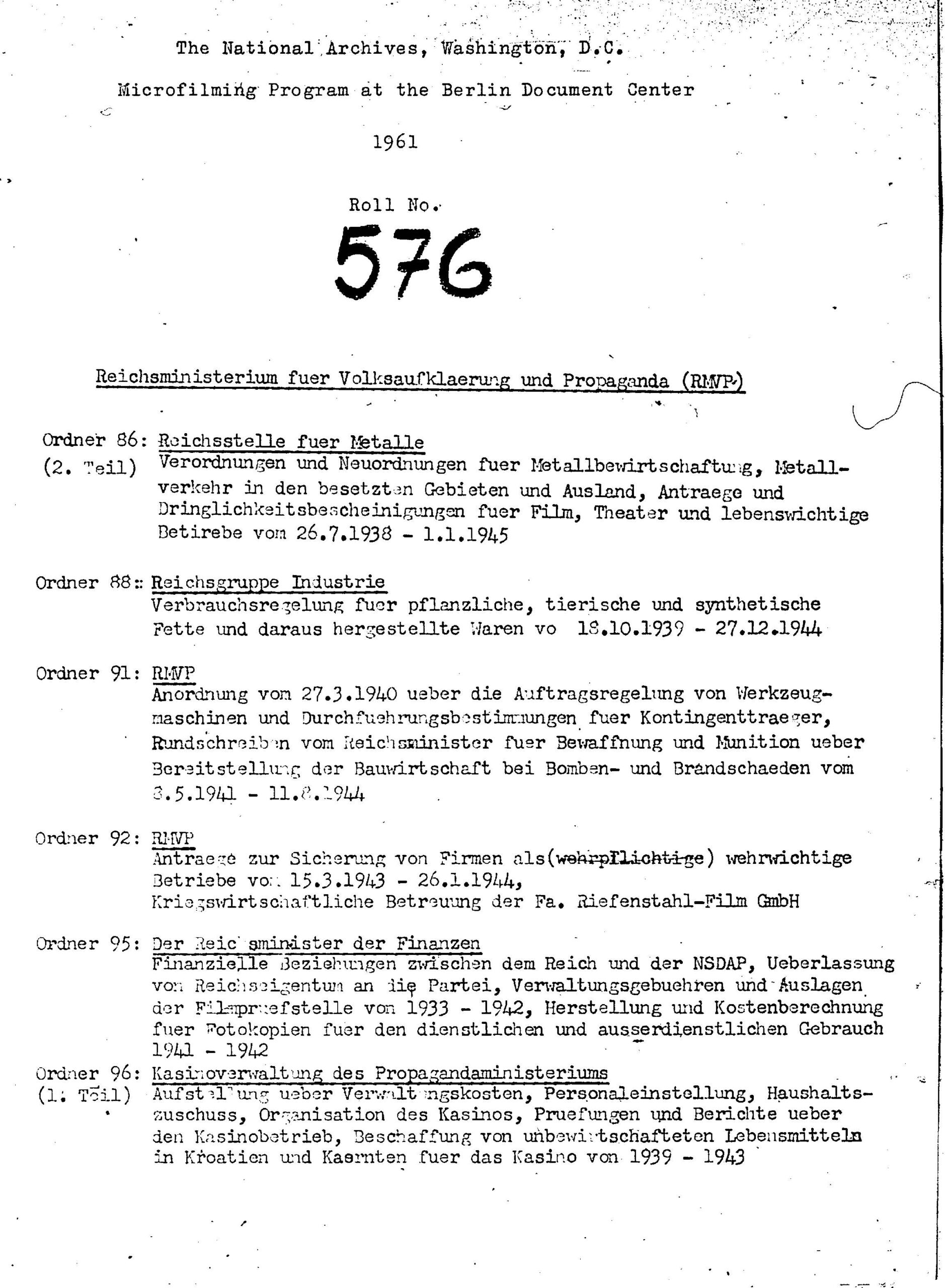
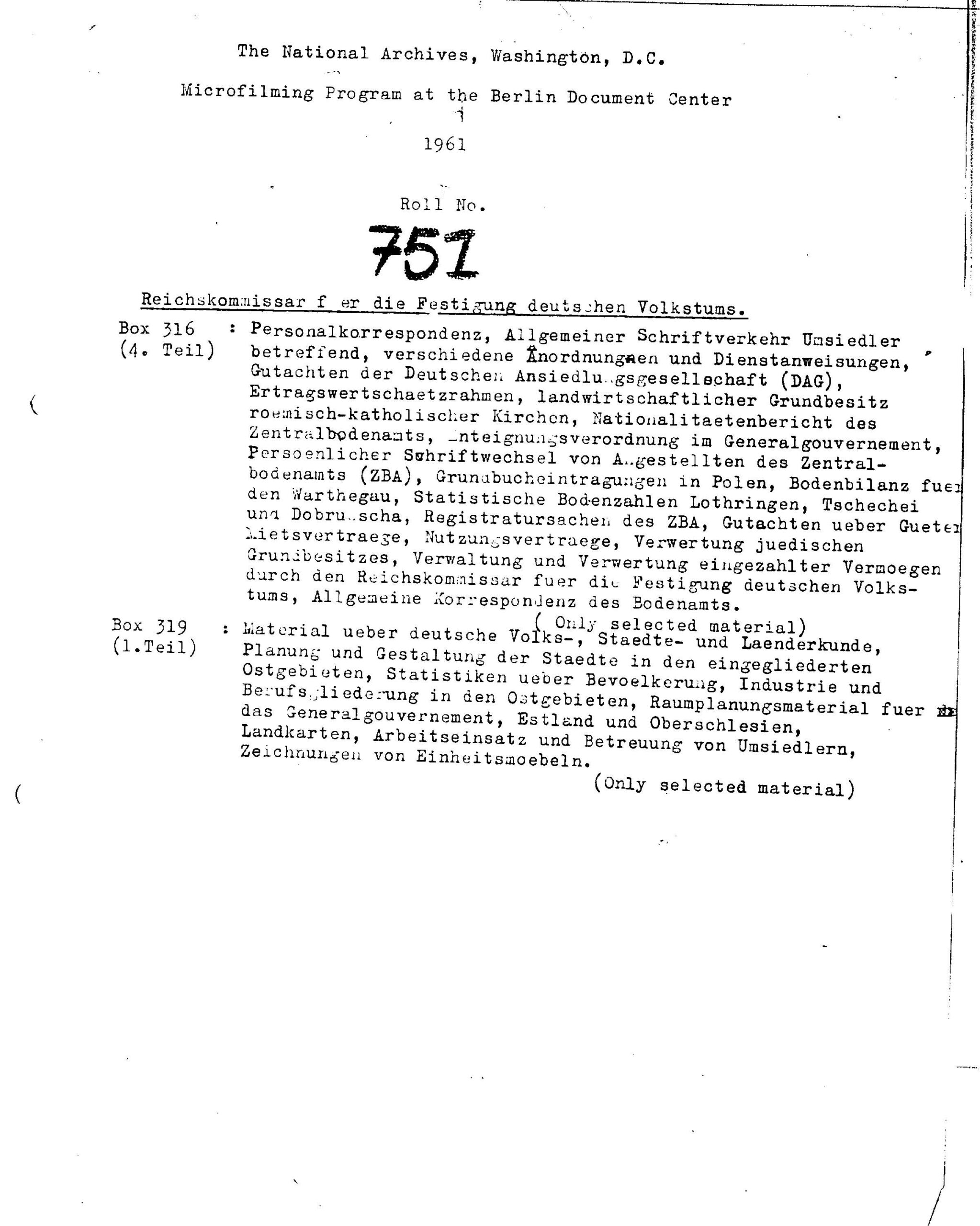
Roll lists and folder‑level entries for BDC microfilm, covering major Nazi‑era organizations, records groupings, and personal papers. Each entry typically identifies the organization/series, Ordner (folder) numbers, and brief content notes, sometimes indicating when an Ordner was not filmed. Examples include Ahnenerbe records, Propaganda Ministry files (Reichsfilmkammer, etc.), party organization files, BDC “Schumacher‑Material” (misc. non‑biographic), and Nachlässe (e.g., Darré).
Scope and content (selected highlights with page references in this PDF):
- BDC “Schumacher‑Material” (Miscellaneous Non‑Biographic Material): Group I–III entries begin at early pages (e.g., Roll No. 1–3 on pp. 2–4). Further “Schumacher‑Material” groups (e.g., Group VIII) appear around pp. 31–33.
- Reichsführer‑SS “Ahnenerbe”: Extensive runs of Arbeitsberichte und Korrespondenz, diaries, correspondence, expeditions, and subject files (e.g., Karst/Höhlenkunde; Germanenkunde; Tibetexpedition; Nordische Gesellschaft), with many roll headers across the file (e.g., pp. 141–144, 170–180, 216–217).
- Reichsministerium für Volksaufklärung und Propaganda (RMVP): Includes Reichsfilmkammer and financial/organizational files for film companies; entries around pp. 624–635.
- Reichsorganisationsleiter der NSDAP: Student organizations, Reichsjugendführung, “Mitteilungen zur weltanschaulichen Lage,” and planning series; see pp. 543–544 and following.
- Nachlässe / Darré: Ahnenforschung files, diaries, correspondence, and school/organizational records; see the run around pp. 250–254 and later.
Disclaimer
This file is an index to the National Archives’ Microfilming Program at the Berlin Document Center (1960–1962).
It summarizes microfilmed records from Nazi‑era bodies, including the Reichskulturkammer (RSK), the Propaganda Ministry (RMVP), and the SS “Ahnenerbe.”
Original folder titles and descriptions are reproduced verbatim for accuracy and therefore contain discriminatory, antisemitic, and violent terminology (e.g., “Judenfrage,” “Verwertung jüdischen Grundbesitzes”); inclusion does not imply endorsement.
Coverage is uneven: some folders were not filmed or contain only selected material, and portions derive from OCR/transcriptions of German‑language sources—errors or omissions are possible.
This guide is provided for research and educational use only and is not legal advice. Rights in the underlying documents may reside with third parties; reuse, publication, or redistribution of images/microfilm may require permission and proper citation to the National Archives/Berlin Document Center.
Condition Note
The file is a high-resolution digital scan of a mid-20th-century typescript index. Overall condition is stable and legible, with only minor degradation typical of microfilm derivatives:
-
Text clarity: The majority of pages are sharp, with distinct typewriter fonts and clear headings such as “The National Archives, Washington, D.C. — Microfilming Program at the Berlin Document Center”. Some sections show faint characters or uneven contrast due to the original carbon copy and microfilm exposure levels.
-
Completeness: Pagination appears continuous (≈1,063 pages) with intact roll headers and series divisions. No major page loss is evident.
-
Defects: Occasional streaking, shadowed edges, and slight curvature at margins—likely from camera alignment during filming. A few pages display blurring or partial over-exposure but remain decipherable.
-
Legibility in German diacritics: Umlauts and sharp-s characters are sometimes degraded or OCR-misread (e.g., “Ahnenerbe” vs. “Ahnenerbë”); verify critical terms manually.
-
Physical annotations: None visible beyond printed filming targets and internal “not filmed” or “selected material only” remarks, which are part of the original document rather than later markings.




Reviews
There are no reviews yet.