

A compiled set of confidential internal documents from Mussolini’s personal secretariat and senior Fascist offices, documenting political, military, and diplomatic decision-making within the Italian Fascist regime from its consolidation through its collapse in 1943.
Report
-
Sale!
 Archives
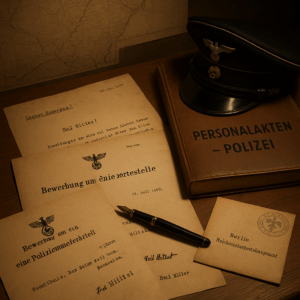
SS Correspondence and Police Career Records, 1940–1944 (Irving File 4H-2)
Add to cartThis file contains personal and official correspondence related to SS and police personnel between 1940 and 1944, including applications for transfers, promotions, service records, and ideological affirmations of loyalty to the Nazi regime.
-
Sale!Internal Communications
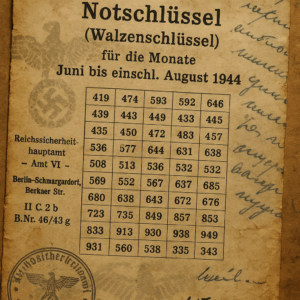
Nazi Germany Reich Security Cipher Key Files (1943–1944) (Irving File 4J)
Add to cartUnlock the secrets of Nazi Germany’s intelligence apparatus with these original Reich Security Cipher Key Files—vital documents used for encrypted communication across the Third Reich’s security services. A rare insight into the hidden code systems of the era.
-
Sale!Archives
Loge zur Gerechtigkeit – Membership and Correspondence Archive (1906–1933)(Irving File 4G)
Add to cartThis archive contains membership records, applications, and internal correspondence of the Loge zur Gerechtigkeit, a German Druid order, documenting names, professions, addresses, and initiation details of members from 1906 to 1933. It also includes personal declarations, exit notices, and lodge administrative communications.
-
Sale!Archives
German Wartime Administrative and Identity Records (1942-1943) (Irving File 8C)
Add to cartThis file is a compiled archive of German wartime administrative and identity records from 1942–1943, including personnel certificates, labor assignments, arrest notices, and escape reports, primarily concerning foreign workers and prisoners of war. It features official stamps, photographs, and handwritten notations across hundreds of scanned historical documents.
-
Sale!Archives
Third Reich Correspondence, Telegrams, and Propaganda Files (1938–1941) (Irving File 64A)
Add to cartThis 394-page compilation of Third Reich documents (1938–1941) contains diplomatic telegrams, propaganda ministry records, Goebbels’ speeches, film evaluations, press monitoring reports, and Hitler’s official schedules, reproduced from the Bundesarchiv. It offers a rare cross-section of Nazi Germany’s diplomatic, cultural, and propaganda apparatus during the early war years.
-
Sale!Archives
Translated Nazi Era Reports & Press Clippings (1935–1936) (Irving File 6A)
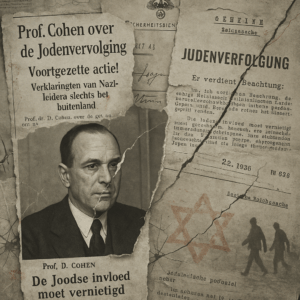
Add to cartThe file contains translated reports and press clippings from 1935–1936 documenting Nazi-era anti-Jewish policies, propaganda, and international reactions, with commentary from figures like Prof. Cohen and Dr. Rosenfeld.
-
Sale!Archives
German Administrative Correspondence Register – 1930s Archive (Irving File 7D)
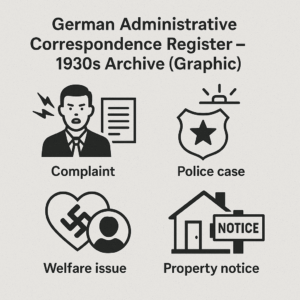
Add to cartThis file is a German administrative correspondence register from the 1930s , cataloguing incoming letters, memos, and official documents with handwritten notes on dates, senders, subjects, and processing status across 535 pages. It reflects bureaucratic record-keeping and processing workflows from the pre-WWII era.
-
Sale!Archives
Erhard Milch Wartime Conferences Luftwaffe Strategy, Me 262 Policy, and Aircraft Production, 1943–1944 (Irving File 53B) – Negative Reel
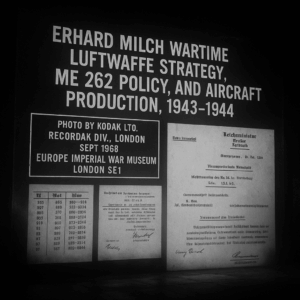
Add to cartThis document is a rare compilation of WWII Luftwaffe high command transcripts and production records, centered on debates over the Me 262 jet aircraft’s bomber vs. fighter role and the urgent construction of underground aircraft factories by the Organisation Todt in 1943–44. It captures candid discussions among Milch, Messerschmitt, Galland, and others, revealing Nazi aviation strategy under extreme wartime pressure.
-
Sale!Directives
German–Spanish Economic Negotiations, 1940 Draft Trade Agreement (Irving File F-18)
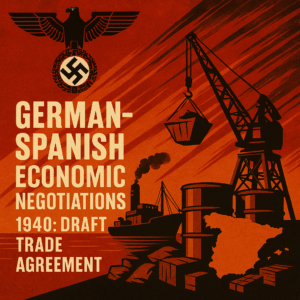
Add to cartA 1940 German Foreign Ministry dossier detailing proposed economic agreements with Francoist Spain, including the full draft of a Sonderabkommen über den Warenverkehr outlining mutual raw-material exchanges, credit mechanisms, and Rowak–Sofindus administration for a potential Axis trade alliance.
-
Sale!Archives
German Army Administrative Bulletins & Honor Lists (1944-1945) (Irving File 7B)
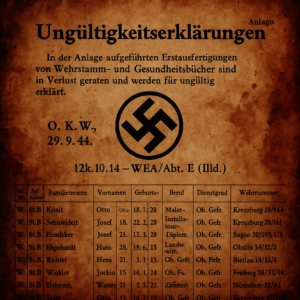
Add to cartThis file is a compiled set of official German Army administrative bulletins from 1944–1945, containing personnel notices, document invalidations, honor lists, daily orders, and regulations issued by the High Command (OKH) during World War II.
-
Sale!Archives
SD Religious Surveillance Reports – Germany 1939–1940 (Irving File 4L)
Add to cartThe document details SD surveillance of religious activities in Nazi Germany (1939–1940), focusing on clergy conduct, church services, and perceived anti-state behaviors within Catholic and Protestant communities. It highlights state efforts to monitor and suppress religious influence, especially among POWs and youth.
-
Sale!Appointments Diary
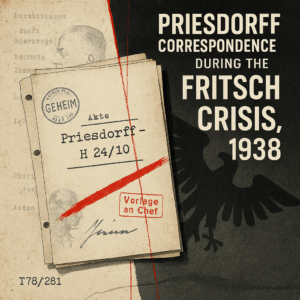
Priesdorff Correspondence During the Fritsch Crisis, 1938 (Irving File T78-281)
Add to cartCorrespondence between military historian Kurt von Priesdorff and the German Army High Command (1935–1940) concerning officer biographies and a Gneisenau manuscript project, which was abruptly canceled during the 1938 Fritsch crisis due to political fallout. The file reveals how military historiography intersected with institutional censorship and regime loyalty under Nazi pressure.
-
Sale!Archives
Archival Name & Reference Compilation (Irving File 8F)
Add to cartThis file is a compilation of German Army administrative bulletins from 1944–1945, featuring document invalidations, personnel lists, military orders, and obituaries issued by the Wehrmacht High Command during World War II.
-
Sale!Archives
Inventories and Surveillance Reports on German Sociopolitical and Religious Organizations 1920s–1950s (Irving File 5)
Add to cartInventories, publication listings, and surveillance records of German and European sociopolitical, religious, and Marxist-affiliated organizations from the 1920s to 1950s. It includes press holdings, membership logs, and publication catalogs—often annotated with missing issues, publishing details, and government surveillance notes (e.g., Gestapo records).
-
Sale!Archives
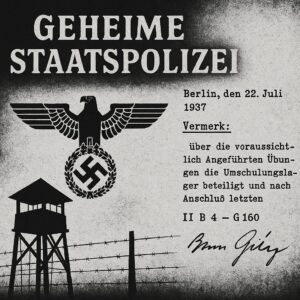
Gestapo Surveillance Dossier Folkish Faith Groups & Cremation Societies (1935–1937) (Irving File 4)
Add to cartThis dossier documents Gestapo surveillance of folkish faith groups and cremation societies between 1935–1937, focusing on their alleged ideological ties to banned movements like the Tannenbergbund and Freethinkers, as well as their perceived political unreliability.
-
Sale!Archives
Criminal & Security Reports from Königsberg Criminal Police incl. Białystok & Zichenau, 1942) (Irving File 8D)
Add to cartThis file is a comprehensive collection of 1942 criminal and security reports from the Königsberg Criminal Police, covering regions like Białystok and Zichenau, detailing murders, thefts, arrests, fugitives, and administrative directives under Nazi occupation.
-
Sale!Archives
SD-Hauptamt Sachkartei- und Sachaktenordnung Organisationsschema und Auswertungsrichtlinien (Irving File 3B)
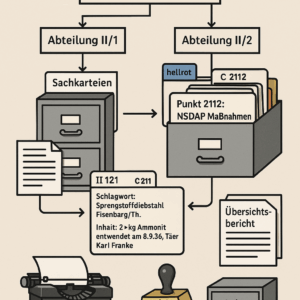
Add to cartThis document outlines the SD-Hauptamt’s internal system for organizing, coding, and analyzing political and social intelligence using a structured index-card (Sachkartei) and subject-file (Sachakte) framework. It provides detailed guidelines for categorization, documentation, and reporting of surveillance information across ideological enemies and societal domains.
-
Sale!Archives
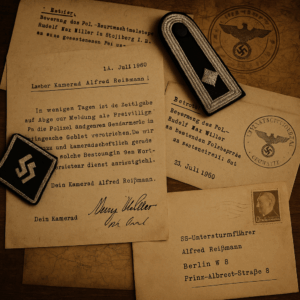
Correspondence and Service Records of Rudolf Max Müller and Associates (1940–1942 )(Irving File 4I)
Add to cartThe document contains wartime correspondence (1940–1942) between German police and SS officers, detailing personnel matters, deployment requests, and personal updates amid broader administrative and military contexts.
-
Sale!Archives
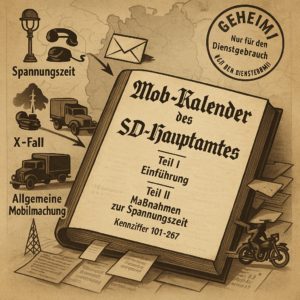
SD-Hauptamt Mobilization Calendar (Mob-Kalender) (Irving File 3F)
Add to cartA detailed Nazi-era mobilization manual for the SD (Sicherheitsdienst), outlining procedures, personnel actions, and operational readiness plans in the event of war. Includes structured directives, coded checklists, and administrative protocols.
-
Internal Communications
Gestapo and Administrative Reports on Jewish Training Camps and Organizations, 1935–1938, (Irving File 4R)
Add to cartA 764-page archival compilation of Nazi-era documents (1937–1945), including Gestapo surveillance reports on Jewish training camps and organizations, administrative correspondence, and propaganda newspaper clippings. Preserved as a historical record of state control, antisemitism, and wartime propaganda.
-
Sale!Archives
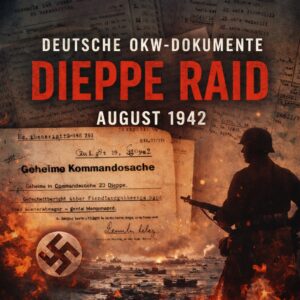
German High Command Papers on the Dieppe Raid (1942) (Irving File 312-504)
Add to cartA collection of German High Command reports reconstructing the Allied Dieppe Raid of 19 August 1942, detailing the landings, objectives, troop composition, German defensive response, and the German conclusion that the scale of forces used meant it was far more than a simple raid.
-
Sale!Archives
Police and SA Records on Surveillance, Discipline, Purges, and Training, 1921–1944 (Irving file T81-90)
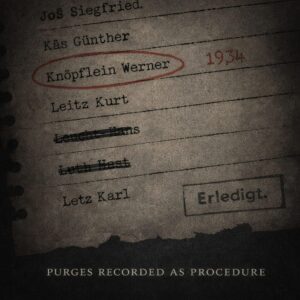
Add to cartComposite police, SA, and security service records documenting surveillance, discipline, internal purges, and training of the Sturmabteilung from the Weimar period through the Second World War. The file exposes how the SA was monitored, controlled, and periodically dismantled through bureaucratic procedure, including the 1934 purge and later wartime repurposing.
-
Sale!Archives
German Military and SS Administrative Records Orders, Transport Lists, and Situation Reports, 1945 (Irving file T78-304)
Add to cartA large compilation of original German Wehrmacht and SS administrative documents from the final phase of the Second World War and its immediate aftermath, including operational orders, transport directives, troop movement records, and logistical reports. The file preserves contemporaneous bureaucratic records documenting military administration during collapse, surrender, and postwar processing.
-
Sale!Archives
German Foreign Office Circulars and Internal Directives (F19 Series) (Irving file T120-624)
Add to cartA compilation of internal circulars, directives, and administrative communications issued by the German Foreign Office, documenting how policy and procedural instructions were distributed and implemented across departments during the National Socialist period.
-
Sale!Archives
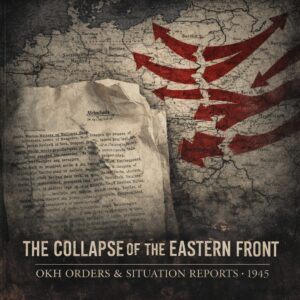
The Collapse of the Eastern Front OKH Orders and Situation Reports, 1945 (Irving file T120-623)
Add to cartA collection of German Army High Command operational orders and situation reports documenting the rapid military collapse of the Eastern Front during the final months of the Second World War in 1945. The file captures real-time command decisions made under conditions of strategic failure and disintegrating control.
-
Sale!Expenditure record
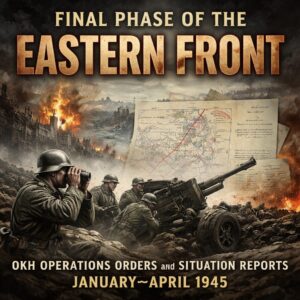
Final Phase of the Eastern Front OKH Operations Orders and Situation Reports, January–April 1945 (Irving file T78-305)
Add to cartA collection of original OKH General Staff operational orders, situation reports, and maps documenting high-level decision-making and command breakdown on the Eastern Front during the final months of the Second World War, January–April 1945.
-
Sale!Diary
Anonymous Letters to Hitler and Internal NSDAP Correspondence (Irving file DJ23)
Add to cartA composite file of anonymous letters sent to Adolf Hitler, together with internal NSDAP and Reich administrative correspondence showing how unsolicited petitions, denunciations, and rumors were processed within the Nazi bureaucracy.
-
Sale!Directives
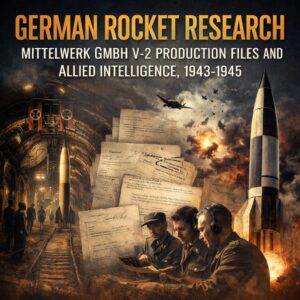
German Rocket Research Mittelwerk GmbH V-2 Production Files and Allied Intelligence, 1943–1945 (Irving file DJ24)
Add to cartA comprehensive primary-source compilation documenting the underground production of the V-2 rocket at Mittelwerk GmbH, combining German wartime administrative and technical records with Allied intelligence reports and postwar investigations from 1943 to 1945.
-
Sale!Archives
Nazi Security Police Administrative and Organizational Records, 1944 (Irving file T175-432)
Add to cartAdministrative and organizational records documenting the structure, procedures, and internal operations of the Nazi security police in 1944, reproduced from U.S. National Archives microfilm. The file illustrates how the RSHA, Gestapo, and criminal police maintained bureaucratic control and reporting systems during the final phase of the Third Reich.
-
Sale!Archives
Groscurth Papers Confidential German Army Records, 1938-1940 (Irving file T84-229)
Add to cartA primary-source collection of confidential German Army memoranda, correspondence, and reports from 1938-1940 documenting internal Wehrmacht operations, resistance networks, and conflicts with the SS during the early Second World War.
-
Sale!Directives
SS Correspondence and Security Instructions for Hitler’s Entry into Austria, 1938 (Irving file T175=241)
Add to cartPrimary SS and RSHA records containing correspondence, personnel lists, and security instructions documenting the planning and execution of Adolf Hitler’s protected entry into Austria during the 1938 Anschluss.
-
Sale!