
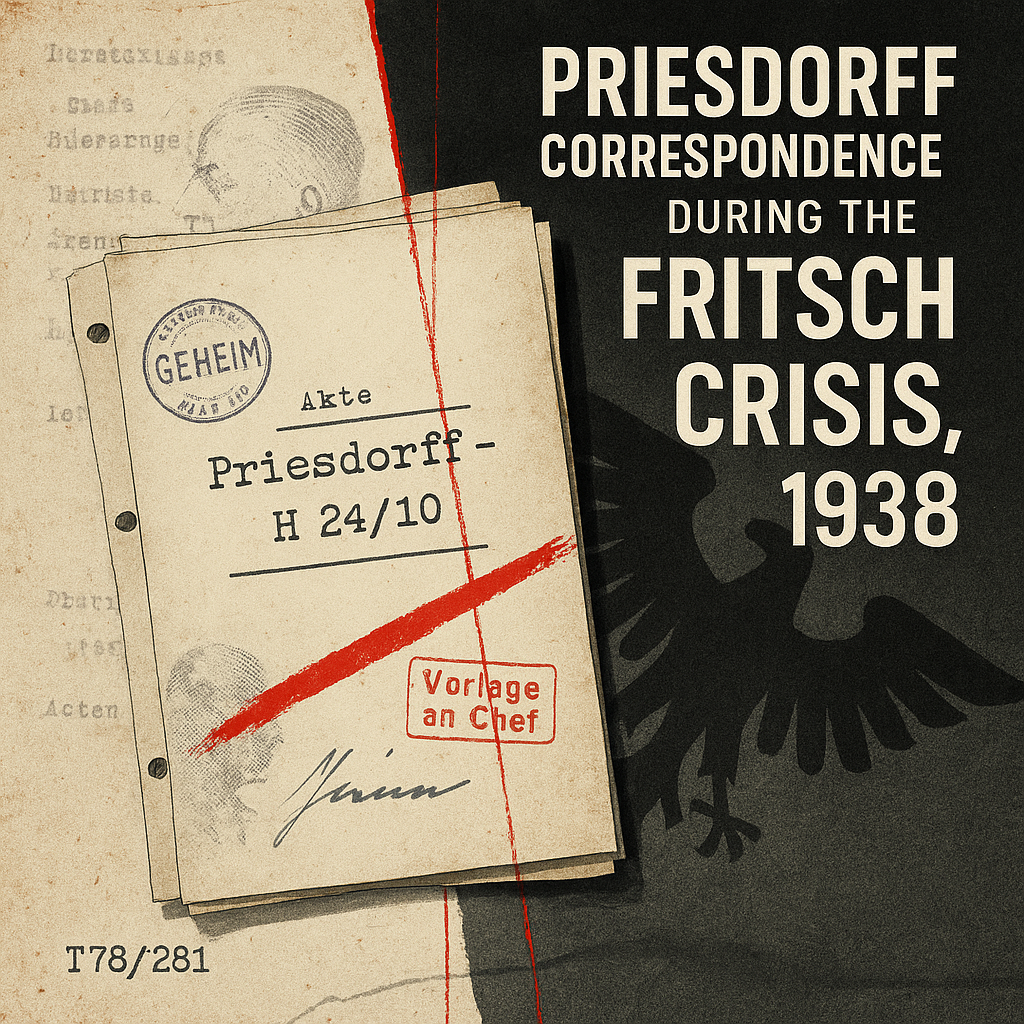
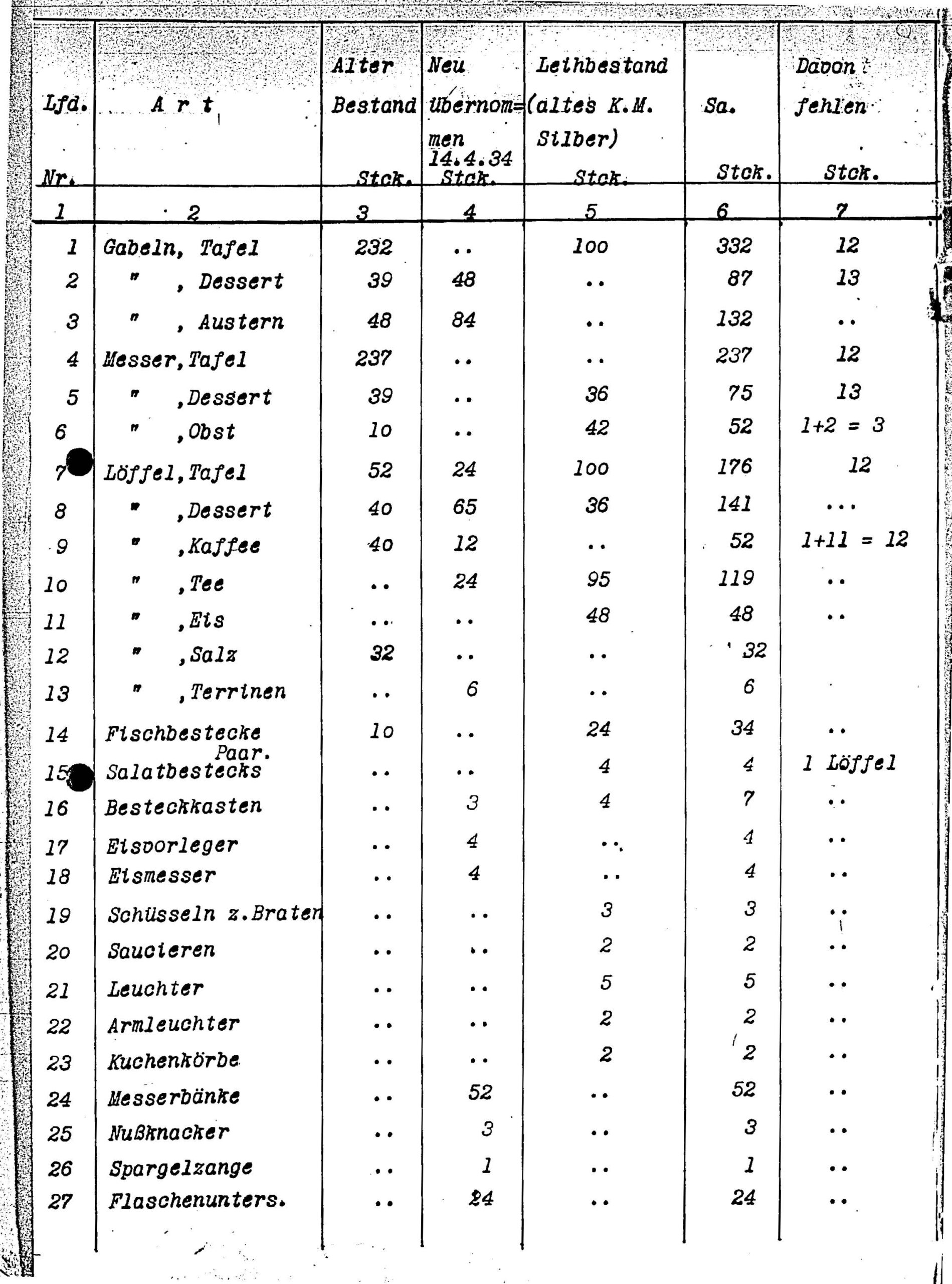
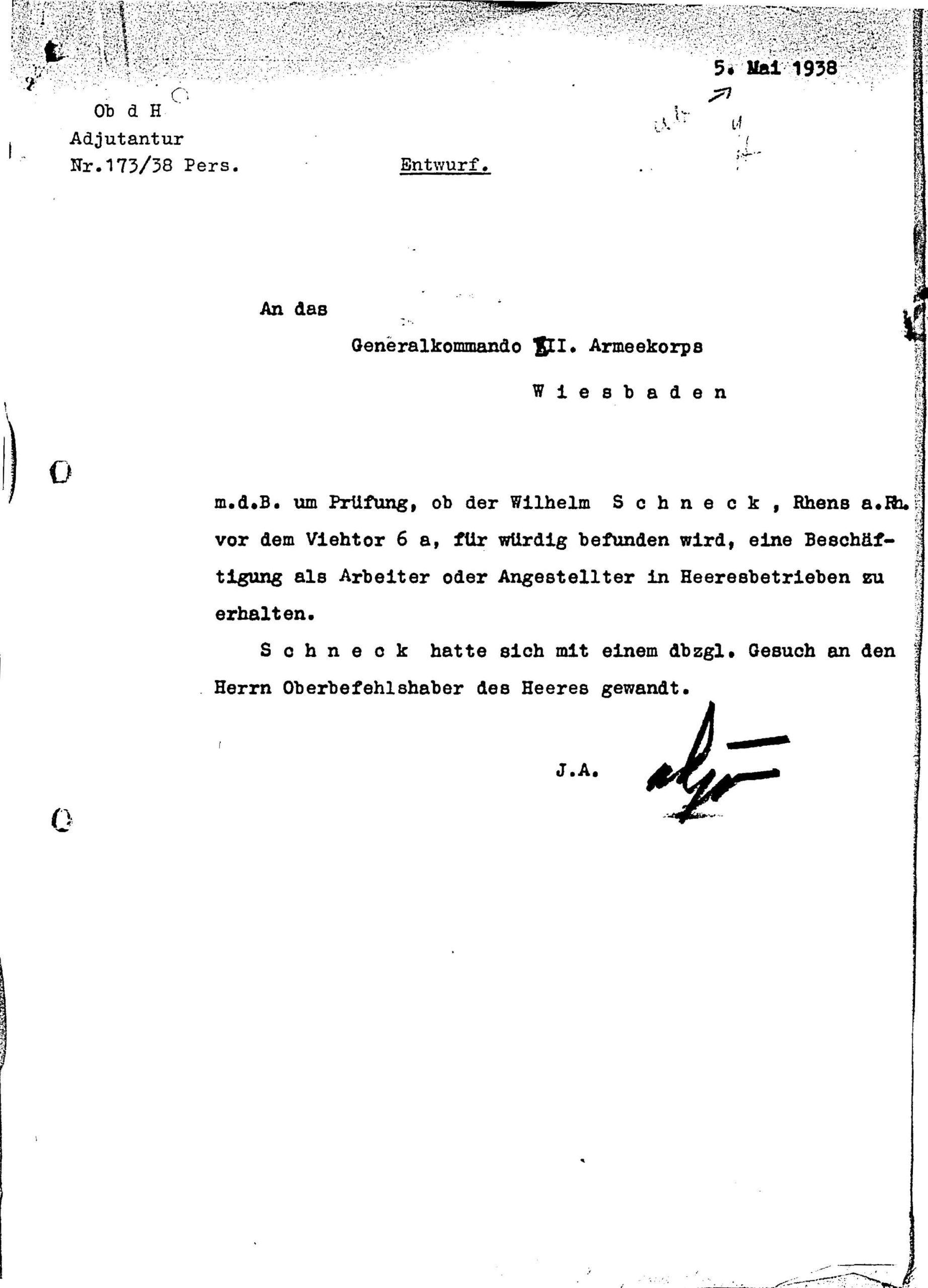
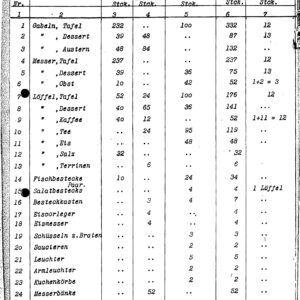
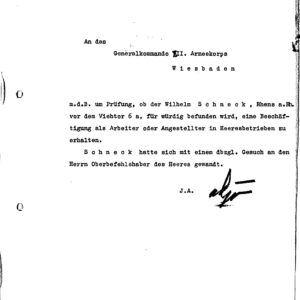
The file contains incoming and outgoing correspondence between the Heeresleitung / OKH and von Priesdorff concerning:
Planning, writing and publication of Priesdorff’s officer biographies and related studies (including his Gneisenau biography).
Requests for official support, recommendations and subsidised distribution of his books within the Army.
Queries and decisions about which generals and officers should be treated, emphasised or omitted in forthcoming volumes.
Internal evaluations of Priesdorff’s work by Army officers (praise, criticism, reservations).
A marked change of tone and caution around 1937–1938 as the Fritsch affair unfolds:
hesitations over endorsing or circulating works that might appear to celebrate officers now under suspicion or removed from command;
signs of increased political vetting and self-censorship within the Army apparatus;
more formal, non-committal language from the Heeresleitung in later letters.
Later (c. 1939–1940) follow-up correspondence on availability of volumes, reprints, and ongoing use of the series as a reference tool for the Army.
Overall, the file documents how a semi-official historian negotiated his position and publications with an increasingly politicised Army leadership, and how the Fritsch crisis directly affected decisions about sponsorship, circulation and the acceptable portrayal of senior officers in print.
Disclaimer
This file forms part of the captured records of the German Army (Heeresleitung / Oberkommando des Heeres) under National Socialist rule. It reflects the language, attitudes, political loyalties and prejudices of its time, including uncritical references to the Nazi state and its leaders.
The presence of names, ranks, honours, or positive characterisations of individuals in this correspondence does not imply agreement with, or endorsement of, their actions, political views, or later careers. The material is presented solely as a historical source to document how military historiography and officer biographies were discussed and controlled during the Fritsch crisis of 1937–1938.
Some users may find the language or perspectives contained in these documents disturbing or offensive. They are made available for research, documentation and critical analysis only.
Condition Note
This file survives in microfilm format as part of T78 Roll 281, digitized from the original paper records of the Heeresleitung (German Army High Command). The overall condition is good and stable, though researchers should note the following:
-
Image quality is generally legible, with standard variations due to original typing, carbon copies, and archival handling.
-
Some pages show uneven contrast, particularly carbon copies and onion-skin paper, which may require magnification or digital enhancement.
-
Occasional punch holes, fading stamps, or rubber-stamp overlays may obscure marginal notes or typed lines.
-
Handwritten signatures and annotations are preserved and mostly clear but may require paleographic familiarity with 1930s German cursive.
There is no indication of missing pages or structural damage, and the sequence of documents appears intact and chronological. The file offers complete research usability in its current scanned microfilm form.
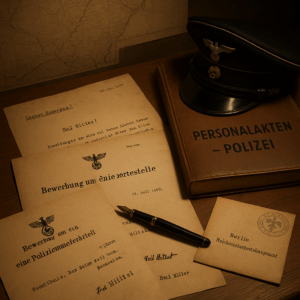
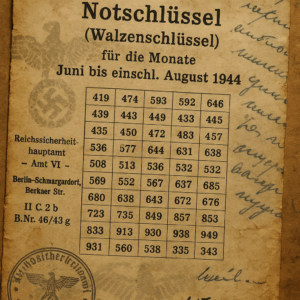
4 Page Sample Priesdorff Correspondence During the Fritsch Crisis, 1938 (Irving File T78-281)
Reviews
There are no reviews yet.